
Website Design & Development
in Iceland
Structured business websites built with technical architecture, responsive implementation, SEO foundations,
performance, analytics, integrations, and long-term scalability.
Information Architecture
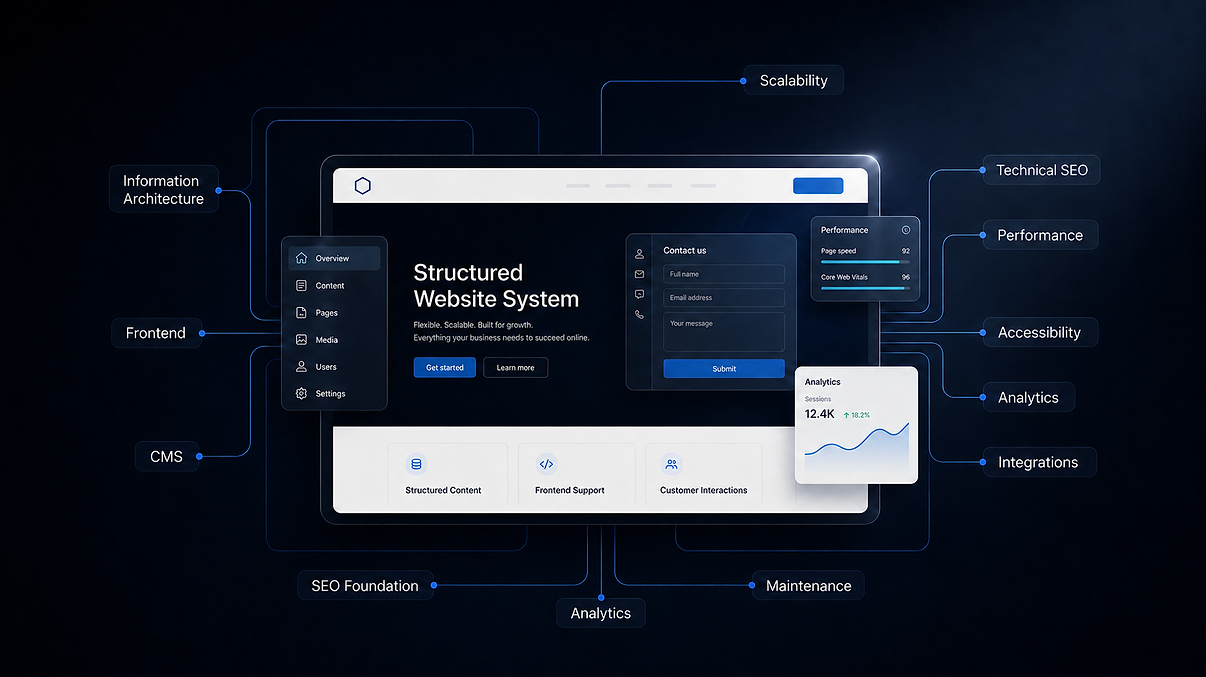
A professional business website starts with information architecture. Before the visual design, animations, colors, or individual sections are created, the website needs a clear structural plan. This defines what pages are needed, how those pages relate to each other, how the navigation should work, and how users move from general information to more specific content.
Information architecture includes page hierarchy, navigation logic, URL structure, service-page planning, content grouping, and internal linking. These elements determine whether the website feels clear and easy to understand, or fragmented and difficult to navigate. A website can look visually polished and still perform poorly if users cannot quickly understand where they are, what the business offers, or which page contains the information they need.
For a service-based business website, this structure is especially important. The homepage should introduce the business clearly, but it should not carry the full responsibility of explaining every service in detail. Individual service pages allow each offer to be explained with stronger context, clearer technical depth, relevant internal links, and more focused SEO targeting. This gives both visitors and search engines a better understanding of the business and its areas of expertise.
At MRKX Labs, website architecture is planned before the design layer begins. This means defining the main pages, supporting pages, service-page structure, navigation labels, URL hierarchy, and internal content relationships. The goal is to create a website that is easier for users to follow, easier for search engines to understand, and easier to expand as the business grows.
A strong information architecture also prevents one of the most common website problems: uncontrolled growth. Many websites start simple, then become messy as new pages, services, blog posts, portfolio items, and legal pages are added without a system. By planning the structure properly from the beginning, the website becomes a scalable digital foundation rather than a collection of disconnected pages.
Frontend Implementation
Frontend implementation is the technical layer where the design becomes a working website. It controls how the interface looks, responds, adapts, and behaves across real devices, screen sizes, browsers, and user situations. This is where visual design, layout structure, interaction behavior, and technical execution meet.
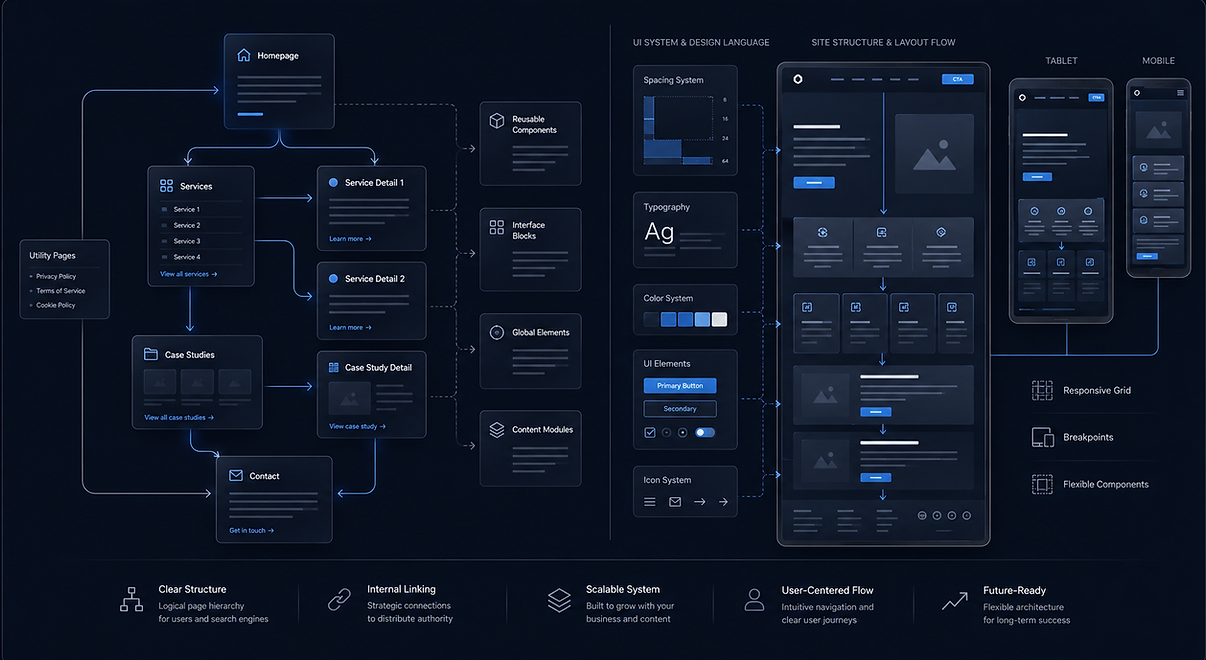
A professional frontend is not built from random sections placed manually on a page. It should use consistent layout rules, reusable components, typography systems, spacing patterns, button styles, form states, hover states, focus states, and responsive behavior. These details make the website feel stable, intentional, and professional instead of improvised.
Responsive website development is more than making a desktop design smaller on mobile. A good responsive layout considers how content should be reordered, how navigation should behave, how buttons should be placed, how forms should be used, how text should remain readable, and how interaction changes between mouse, keyboard, and touch devices. Mobile, tablet, and desktop experiences need to be checked as separate usage contexts, not treated as one design stretched into different sizes.
Browser compatibility is also part of frontend quality. A website may look correct in one browser and behave differently in another, especially across Safari, Chrome, Firefox, iOS, Android, desktop screens, and tablets. Small inconsistencies in spacing, fixed elements, animations, forms, or embedded content can damage the user experience if they are not tested properly.
At MRKX Labs, frontend implementation focuses on controlled structure and reliable behavior. The website is built with reusable visual patterns, consistent spacing, readable typography, responsive layouts, clear interface states, and device-aware adjustments. The goal is not only to make the website look good, but to make it behave consistently in real usage.
This is where many low-quality websites fail. They may look acceptable in a preview, but break when content changes, when viewed on tablets, when opened in Safari, when a form error appears, or when a section is duplicated later. A professional website needs a frontend system that can support the design beyond the first launch.
CMS and Content Structure

A business website should be easy to update without becoming unstable. This is where CMS and content structure become important. A website is not only a set of pages; it is also a content system that may include services, portfolio items, case studies, blog posts, FAQs, testimonials, team members, locations, legal pages, and reusable content sections.
Without structured content, websites often become difficult to maintain. The same section gets manually copied across several pages, service descriptions become inconsistent, portfolio layouts change from item to item, FAQs are repeated in different formats, and every new page requires unnecessary manual design work. This creates more room for mistakes and makes the website harder to scale.
A structured CMS approach organizes recurring content into manageable content types. For example, a service can have a title, short description, full explanation, related image, FAQ section, SEO title, meta description, and call-to-action. A portfolio item can have a project name, industry, challenge, solution, result, image gallery, and related services. A FAQ can be managed as a reusable content item instead of being typed manually in multiple places.
At MRKX Labs, CMS and content structure are planned around how the website will be used after launch. The goal is to make important content editable where it makes sense, while protecting the structure, design consistency, and technical quality of the website. This gives the client practical control without turning the website into an unstable editing environment.
Good content structure also supports SEO and future growth. When services, portfolio items, case studies, FAQs, and blog posts follow a clear structure, the website becomes easier to expand and easier to understand. New pages can be added with consistency, internal links can be managed more logically, and the website can grow without losing its original structure.
Technical SEO Foundation
Technical SEO is the foundation that helps search engines crawl, index, and understand a website. It is not a trick, shortcut, or separate task that should only be considered after the website is finished. A serious website design and development process should include SEO foundations from the beginning.
This includes crawlable pages, indexable structure, clean title tags, relevant meta descriptions, logical heading hierarchy, canonical handling, XML sitemap setup, structured data where appropriate, internal links between important pages, and clear URL structure. These elements help define what each page is about, how pages relate to one another, and which pages should be discoverable in search.
For a business website, technical SEO is especially important on service pages. A generic services overview page is rarely enough if the business wants search visibility for specific offers. Individual service pages allow the website to target more specific search intent, explain each service in more depth, and build stronger topical relevance around the business.
Headings also matter. A clear H1 should define the main topic of the page, while H2 and H3 sections should organize supporting ideas in a logical way. This helps users scan the page and helps search engines understand the content structure. Headings should not be used only for visual styling; they should reflect the actual structure of the page.
At MRKX Labs, technical SEO foundations are handled as part of the website build. This means the website is planned with crawlability, indexability, page hierarchy, metadata, headings, internal linking, structured data, sitemap logic, and search visibility in mind. This does not replace long-term SEO strategy, content production, or link acquisition, but it gives the website a stronger technical base.
A website can look complete and still be technically weak for search. If important pages are not indexed, titles are duplicated, headings are inconsistent, canonical tags are unclear, structured data is missing or incorrect, or internal links are poorly planned, the website may struggle to communicate its relevance. Technical SEO reduces these avoidable problems before they become expensive to fix later.
Performance Layer

Website performance is part of website quality. It affects how quickly users can access the content, how stable the page feels while loading, and how responsive the interface is when someone interacts with it. Performance is not only about achieving a high score in a testing tool; it is about making the website feel fast, stable, and usable in real conditions.
A professional performance layer includes image optimization, script control, third-party embed management, loading behavior, layout stability, responsive media handling, and Core Web Vitals awareness. Large images, unnecessary scripts, tracking tools, chat widgets, cookie banners, video embeds, animations, and external integrations can all affect performance if they are not handled carefully.
Image optimization is one of the most visible performance factors. Images should be compressed, sized correctly, served in appropriate formats where possible, and used intentionally. A visually strong website does not need to be unnecessarily heavy. The goal is to preserve quality while avoiding slow loading and excessive page weight.
Script control is equally important. Many websites become slow not because of the design itself, but because too many external tools load at once. Analytics, pixels, cookie tools, booking widgets, embedded maps, chat systems, video players, and marketing scripts all add technical cost. Each script should have a purpose, and unnecessary third-party load should be avoided.
Layout stability is another major part of perceived quality. If text, images, buttons, banners, or embedded elements move while the page loads, the website feels unstable and unprofessional. This can be caused by missing image dimensions, late-loading fonts, dynamic embeds, ads, banners, or poorly planned responsive behavior.
At MRKX Labs, performance is considered during the build process. Media, scripts, embeds, animations, tracking tools, layout behavior, and mobile performance are reviewed with practical usability in mind. The goal is not to remove every advanced feature, but to make sure each technical element has a clear reason to exist and does not damage the user experience unnecessarily.
Accessibility
Accessibility is a core part of professional website development. A website should be easier to perceive, navigate, understand, and operate for as many users as possible. This includes people using different devices, screen sizes, browsers, keyboards, screen readers, assistive technologies, and varying levels of visual, motor, or cognitive ability.
Accessibility basics include semantic headings, readable contrast, meaningful alt text, clear link text, labelled form fields, keyboard-aware interaction, visible focus states, logical content order, and responsive readability. These details are not only important for accessibility; they also improve the overall clarity and structure of the website for all users.
Semantic structure is one of the most important accessibility foundations. Headings should follow a logical order. Buttons should behave like buttons. Links should clearly describe where they lead. Form fields should have proper labels. Images should have meaningful alternative text when they communicate important information. Decorative images should not create unnecessary noise for assistive technologies.
Readable contrast and responsive typography also matter. Text that looks elegant on a large desktop screen may become difficult to read on mobile. Light grey text, thin fonts, small font sizes, low contrast, and poor spacing can make the website feel premium visually but weak in real usability. A professional website needs to balance visual style with readability.
At MRKX Labs, accessibility is approached at a practical website level. The goal is to avoid common structural mistakes such as fake headings, unlabeled forms, inaccessible buttons, missing focus states, poor contrast, unclear links, and layouts that become difficult to read on smaller screens. This does not mean claiming full legal compliance without a dedicated accessibility audit, but it does mean building with accessibility principles in mind from the start.
A more accessible website is usually a better-built website. It has clearer structure, better markup, more usable forms, stronger navigation, and fewer hidden usability problems. Accessibility should not be treated as an optional extra added at the end; it should be part of the design and development process.
Security and Reliability

Even a standard business website can contain security and reliability risks. Contact forms, CMS access, editor permissions, tracking scripts, embedded tools, automation workflows, API integrations, booking systems, and payment connections all create technical responsibilities.
Security at the website level does not always mean complex enterprise cybersecurity. It means reducing avoidable risks in the parts of the website that collect data, connect to external systems, allow editing, or trigger business processes. This includes safer form handling, spam reduction, controlled access, careful third-party script usage, and reliable integration planning.
Forms are a common weak point. A contact form should not only look good; it should submit correctly, validate input, reduce spam, send notifications reliably, and avoid exposing unnecessary technical risk. If the form connects to email, CRM, Google Sheets, automation tools, or other systems, the entire flow needs to be tested.
Access control is another important detail. Not every editor needs full control over every part of the website. A client may need to update blog posts, portfolio items, service descriptions, or images, but should not necessarily be able to accidentally damage the website structure, SEO settings, tracking setup, or technical configuration. Permissions should match real responsibilities.
Third-party tools also create reliability risks. Every external script, plugin, embed, widget, or integration adds dependency. If a third-party system slows down, changes, breaks, or becomes insecure, it can affect the website. This is why external tools should be chosen intentionally and reviewed as part of the website architecture.
At MRKX Labs, security and reliability are handled practically. The goal is to create a website that functions consistently, protects important workflows, limits avoidable risks, and remains easier to maintain. Forms, editor access, integrations, scripts, and post-launch stability are considered as part of the build, not treated as afterthoughts.
Analytics and Measurement
A website should be measurable from launch. Without analytics and measurement, it is difficult to understand how people find the website, which pages they visit, which actions they take, and where the website may be losing potential leads or customers.
Analytics and measurement can include GA4 setup, Search Console connection, form submission tracking, CTA tracking, traffic-source visibility, key event tracking, and basic conversion-path measurement. These elements help turn the website from a static online presence into an observable digital system.
The goal is not to track everything blindly. Too much unstructured data can become useless. A better approach is to define which actions matter: contact form submissions, phone clicks, email clicks, booking actions, quote requests, service-page visits, important CTA clicks, or other meaningful events. These actions should be measured clearly so the business can understand whether the website is supporting its goals.
Search Console is also part of the measurement layer. It helps show how the website performs in Google Search, which pages receive impressions, which queries bring visibility, and whether indexing issues exist. This is essential after launch, especially for new service pages and SEO-focused website structures.
At MRKX Labs, measurement is treated as part of the website foundation. The website should not only be published; it should be observable. With the right tracking foundations, future decisions can be based on actual behavior instead of assumptions. This supports SEO improvements, content planning, conversion optimization, paid campaigns, and long-term website development.
A website without measurement creates blind spots. The business may not know whether visitors are finding the right pages, whether contact forms are working, whether CTAs are being clicked, whether mobile users behave differently, or whether search visibility is improving. Analytics does not solve these problems by itself, but it gives the business the visibility needed to improve.
Integrations

A modern business website often needs to connect with the systems behind the business. Contact forms, CRM tools, email notifications, booking systems, payment systems, automation workflows, spreadsheets, calendars, marketing platforms, and external APIs can all become part of the website architecture.
The mistake is treating integrations as small add-ons. A form is not just a form if it needs to store a lead, notify the team, trigger an email, update a CRM, start an automation, or create a record in another system. A booking or payment flow is not just a button if it involves availability, confirmations, user data, transaction status, reminders, cancellation logic, or error handling.
Integrations need planning because they connect the public website to operational workflows. If this layer is poorly built, leads can be lost, notifications can fail, customer data can become inconsistent, manual work can increase, and the business may not notice the problem until too late.
External APIs and third-party systems also require realistic expectations. Documentation can be limited, authentication may be required, and some tools may not support every desired workflow. These limitations should be understood before promising a specific automated process.
At MRKX Labs, integrations are planned as part of the website system. The goal is to connect the website with the business workflow behind it in a clean, reliable, and maintainable way. This can include contact forms, CRM connections, email notifications, booking tools, payment systems, automation workflows, and API-based connections where appropriate.
A good integration reduces friction. It helps the business respond faster, organize leads better, reduce manual repetition, and create a smoother path from visitor action to business follow-up. This is where the website becomes more than an online brochure: it becomes part of the business operation.
Maintenance and Scalability
A professional website should be built for change. Businesses add services, update offers, publish case studies, expand into new languages, improve SEO, launch campaigns, add integrations, and refine content over time. If the website is not built with this in mind, every future update can become slow, messy, or risky.
Maintenance and scalability include editable content, reusable page templates, future service-page expansion, multilingual readiness, documentation, post-launch QA, redirect awareness, broken-link checks, form testing, tracking validation, and clear ownership of future updates. These details help prevent the website from becoming fragile after launch.
Editable content should be planned carefully. The client should be able to update the content they genuinely need to manage, but the website should not expose unnecessary structural control that can break layout consistency, SEO settings, or technical behavior. A good website gives practical flexibility without sacrificing stability.
Reusable templates are important for growth. If the business later adds a new service page, portfolio item, case study, FAQ section, or localized page, the structure should already support that expansion. This saves time and keeps the website consistent as it grows.
Multilingual readiness is another scalability layer. A multilingual website is not just a translated version of the original. It needs clear page relationships, localized URLs, language-specific metadata, translated navigation, consistent structure, and attention to how search engines understand different language versions. This should be planned before the website becomes difficult to restructure.
Post-launch QA is also part of professional website delivery. After launch, the website should be checked for form functionality, responsive behavior, indexing status, analytics events, broken links, metadata, page speed issues, redirects, and important user flows. Launch is not the moment when quality control ends; it is the moment when the website enters real use.
At MRKX Labs, websites are planned with future growth in mind. The goal is to avoid building a website that only works on launch day. A scalable website has a clear structure, reusable patterns, manageable content, documented logic, and enough technical discipline to support future updates without becoming unstable.